SEO, digital PR and AI search optimisation.Own the search. And the AI answers.
SEO earns the ranking, digital PR earns the trust, and AI search optimisation puts you in the answer buyers read before they click.
Somebody asks an AI for a recommendation
Who should I use for a kitchen fit-out near Guildford?
Volume, recency and rating, across Google and everywhere that republishes it. In a local recommendation this is the loudest signal there is.
Invisible where buyers are looking.
You're not in the consideration set
Competitors own the results for the terms that matter, on Google and now inside ChatGPT and AI Overviews. If the engines don't surface you, buyers never consider you.
Content with no strategy behind it
Posts published on a whim, mapped to nothing. No intent, no internal linking, no compounding authority. Effort with no return.
No authority signals
Without earned coverage and links, search engines have no reason to trust you over the incumbent. You stay stuck on page two.
SEO & AI search, in depth.
SEO is an asset. Paid is a bill.
Every pound you put into Google Ads buys you a click today and nothing tomorrow. Stop paying and the traffic stops the same afternoon. SEO works the other way round. You invest in pages, technical foundations and authority once, and they keep returning visitors for months and years after the work is done. That is the whole case for organic search: it compounds. A page that ranks in month six is still ranking in month eighteen, and by then it has usually climbed, picked up more links and started pulling in related terms you never targeted directly.
That is why we treat SEO as a growth asset on your balance sheet, not a monthly ad spend you have to keep feeding. As an SEO agency in the UK working with mid-market firms, our job is to build a channel that gets cheaper per lead over time, not more expensive. RGS Carpentry is the plainest example we have: organic traffic went from 90 to 461 monthly visitors, a rise of 412%, and qualified enquiries climbed 367%. None of that resets when a campaign ends. It sits there and keeps working.
Read the full guide7 sections · 5 min
- SEO is an asset. Paid is a bill.
- The three pillars: technical SEO, content, and digital PR
- Local SEO and the map pack
- What GEO and AEO actually mean
- How we get AI engines to cite you
- How we measure AI-search visibility
- A realistic timeline
The three pillars: technical SEO, content, and digital PR
Good SEO rests on three things done properly, and skipping any one of them caps the other two.
Technical SEO is the foundation. If Google cannot crawl, render and index your pages quickly, nothing else matters. We fix crawl waste, site architecture, internal linking, Core Web Vitals, structured data and the indexing problems that quietly hold sites back. This is unglamorous work, and it is usually where the fastest wins hide.
Content built for search intent is the engine. We do not write for word counts. We map the actual questions your buyers type and ask, then build pages that answer them better than anything currently ranking. A content strategy that matches intent, from early research queries down to high-commercial terms, is what turns rankings into enquiries rather than empty traffic.
Digital PR is the authority layer. Google still ranks pages partly on who links to them and who talks about them. A digital PR agency earns those links through stories, data and commentary that real publications want to cover, not directory spam or paid link schemes that get penalised. This is link building done the way it survives algorithm updates: editorially earned, on relevant sites, pointing at pages that deserve to rank. SEO earns the ranking; digital PR earns the trust that makes the ranking stick.
Local SEO and the map pack
For any business that serves a place, the Google map pack is the most valuable real estate in search. It sits above the normal results and it is where "near me" searches convert. Local SEO is its own discipline: Google Business Profile optimisation, local landing pages, citation consistency, and a steady flow of genuine reviews.
GR Bucket Biryani shows what that looks like when it works. Google Maps Discovery searches rose 176%, from 2,100 to 5,800 a month, and the profile went from 142 reviews to 221 at 4.5 stars. More people found the restaurant through Maps, and the reviews gave them a reason to choose it. For local firms, that combination of visibility and social proof is often worth more than a national ranking ever would be.
What GEO and AEO actually mean
Search behaviour has changed, and the sites that ignore it will lose ground quietly. In 2026, a large share of buyers ask ChatGPT, Perplexity or Google AI Overviews before they visit a single website. They get a summarised answer with a handful of cited sources, and those cited sources are the new shortlist. If you are not in the answer, you are not in the running, and the buyer may never see a ranking page at all.
Two disciplines address this. Generative engine optimisation (GEO) is about being recommended inside AI-generated answers from tools like ChatGPT and Perplexity. Answer engine optimisation (AEO) is about structuring content so engines can lift a clean, correct answer straight from your page. They overlap, and both come down to the same thing: making your business the source an AI trusts enough to name.
How we get AI engines to cite you
AI models cite what they can understand and what they trust. We build both.
First, an entity and authority footprint: consistent, structured information about who you are across your site, schema markup, and the third-party sources these models train and retrieve from. AI engines reason about entities, so we make yours unambiguous. Second, answer-ready content: clear questions with direct, self-contained answers near the top, the format engines quote from. Third, earned citations and original data: proprietary numbers, research and expert commentary that publications reference and models pick up. This is where digital PR and GEO meet. The same earned coverage that lifts your rankings also feeds the sources AI engines cite.
How we measure AI-search visibility
The reason most "AI SEO" pitches are hollow is that they never turn it into a number. We do. We track your share of AI voice, how often you appear in AI answers for your key prompts against named competitors, so it is a benchmark you can watch move. We isolate AI referral traffic in GA4 to see what ChatGPT, Perplexity and other assistants actually send you. And we read your server logs to track AI crawler activity, so we know which engines are fetching your pages and how often. Share of AI voice becomes a metric on your dashboard, not a promise in a proposal.
A realistic timeline
Anyone guaranteeing page one in 30 days is selling you something. Honest SEO has a shape. You should see early movement in 2 to 3 months as technical fixes land and the first content indexes. Real traction, meaningful traffic and enquiries, tends to arrive in 4 to 6 months. After that it compounds: rankings deepen, authority builds, and the cost per lead keeps falling. Knight Automotive followed exactly that curve, with website traffic growing 220%, from 480 to 1,540 monthly visitors, as the work stacked up rather than spiking and fading.
Want to know where you stand today? Get a free SEO audit and we will show you the technical issues, content gaps and AI-search opportunities we can see. Or see the results from seven live builds across six industries first. Ranking and citing is only half the job, so pair this with conversion rate optimisation to turn the traffic into revenue.
SEO earns the ranking. Digital PR earns the trust.
SEO
The on-site and technical foundation that makes you findable and rankable for the searches that lead to revenue.
- Technical SEO audit & fixes
- Keyword & search-intent mapping
- Content strategy & production
- On-page & internal linking
- Local SEO & Google Business Profile
- Core Web Vitals & site health
Digital PR
The off-site authority that earns the links, mentions and coverage search engines reward, the part you can't buy.
- Story angles & data-led campaigns
- Journalist & publication outreach
- Earned links from real coverage
- Brand mentions & citations
- Founder & thought-leadership placement
- Reputation across the SERP
Be the answer, not just a blue link.
Buyers now ask ChatGPT, Perplexity and Google AI Overviews before they ever click a website. We engineer your content and entity footprint so the AI engines understand, trust and recommend you by name.
Entity & authority footprint
We make Novrex-style sense of who you are to machines: consistent entities, structured data and citations across the web so the models know what you do and who you serve.
Answer-ready content
Content structured the way AI engines extract answers, clear questions, direct responses, and the supporting evidence they quote when they cite a source.
Earned citations & data
Original data and digital PR that becomes the source AI tools reference, the off-site signal that turns you into the recommended option.
Measured share of AI voice
We isolate AI-referred traffic in GA4, track how often ChatGPT, Perplexity and Google AI Overviews name you against your competitors, and read the server logs to see which pages the AI crawlers actually fetch and cite. Visibility becomes a number we move, not a promise.
Why SEO is the asset, not the ad.
Paid stops the moment you stop paying. SEO compounds. Here's the realistic curve.
Foundation
Technical fixes, keyword and intent mapping, and the content plan that targets real demand.
Momentum
Content shipping, on-page dialled in, first digital PR campaigns earning coverage and links.
Traction
Rankings climbing for target terms, organic traffic building, authority signals stacking.
Compounding
Organic becomes a reliable channel that grows while paid spend can come down.
The full organic stack.
Technical SEO audit & fixes
Remove what's holding rankings back.
Keyword & intent mapping
Target the searches that lead to revenue.
Content strategy & production
Pages and posts built to rank and convert.
On-page & internal linking
Structure that compounds authority across the site.
Local SEO
Own the map pack and local searches that drive walk-ins and calls.
Digital PR & link building
Earned coverage and links from real publications.
Core Web Vitals
Fast, healthy pages that search engines favour.
Rank tracking & reporting
Clear visibility on rankings, traffic and what's working.
An asset that keeps paying.
Found, then chosen.
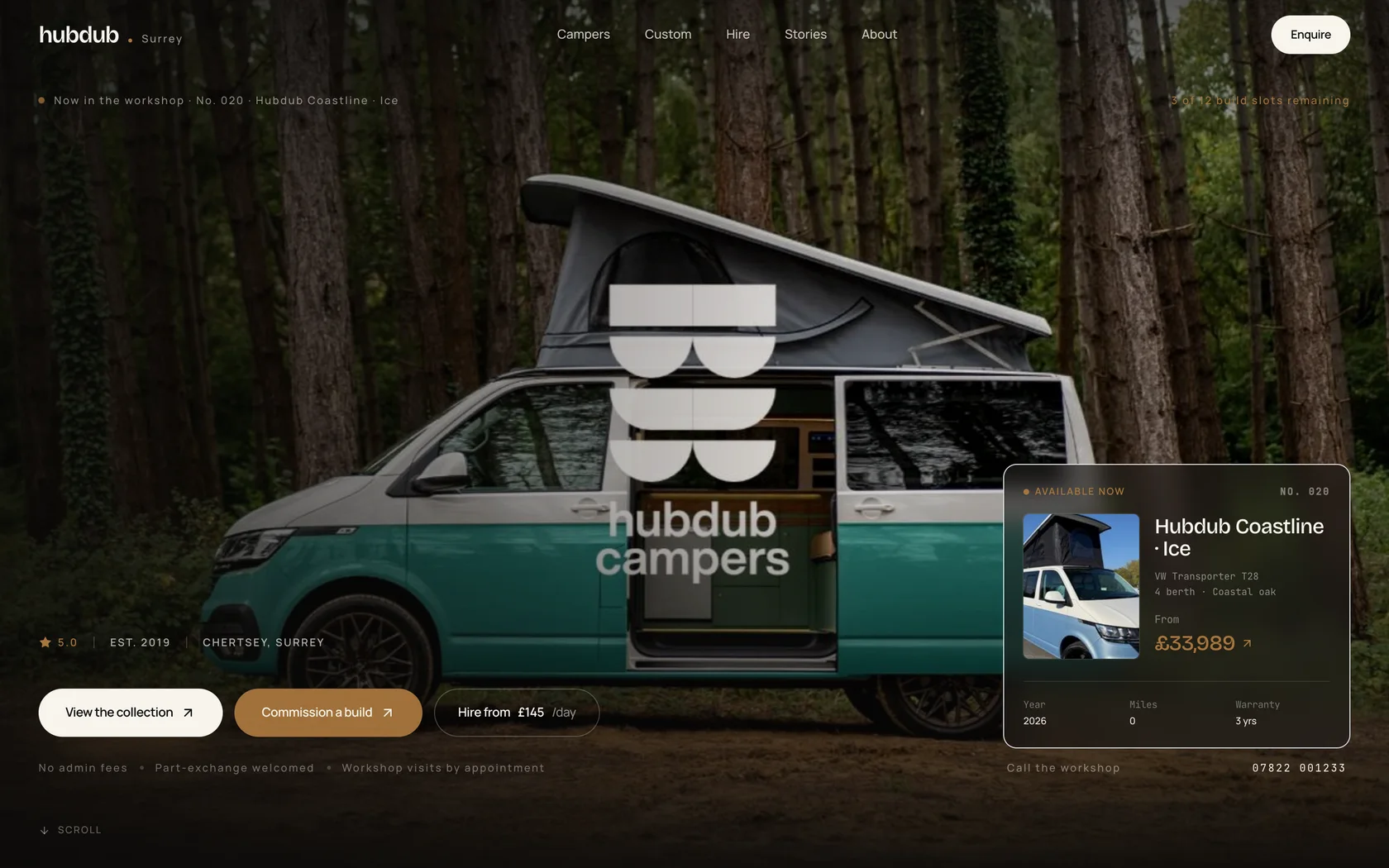
HubDub Campers
A camper conversion business given a site and local SEO foundation built to be found by buyers searching in the area.
See moreSEO & Digital PR, answered.
How long until SEO works?
SEO is a compounding asset, not an instant channel. Early movement often shows in two to three months, with meaningful traction over four to six and compounding gains beyond. We're upfront about the curve.
Do you do local SEO?
Yes. For location-based businesses we optimise your Google Business Profile, local pages and citations to win the map pack and nearby searches.
What is digital PR exactly?
Earning coverage, mentions and links from real publications through newsworthy story angles and outreach. It's the authority side of SEO that you can't simply buy.
Do you write the content?
Yes. We handle strategy and production, built around search intent so each piece has a job to do, not just a word count to hit.
How do you measure it?
Rankings for target terms, organic traffic, earned links and coverage, and ultimately enquiries from organic. We report on outcomes, not vanity.
How do you measure AI search visibility?
Across five linked metrics: AI referral traffic isolated in GA4, share of AI voice (how often you appear in the answer for a fixed set of buyer prompts), citation tracking, AI crawler coverage from your server logs, and answer accuracy. We baseline all five and report the movement every cycle, so being cited by AI is a tracked number rather than a claim. Our full method is published on the Measuring AI Search Visibility guide in Resources.
What is generative engine optimisation (GEO)?
GEO is the practice of getting your business recommended inside answers from AI tools like ChatGPT, Perplexity and Google AI Overviews. It works by building a clear entity footprint, publishing answer-ready content, and earning citations from sources these models trust and retrieve from, so the AI names you when a buyer asks.
How do I get my business cited by ChatGPT?
AI models cite sources they can parse and trust. Structure your content as clear questions with direct answers, add schema markup, keep your business information consistent everywhere, and earn references from reputable publications through original data and digital PR. ChatGPT tends to cite pages that other credible sites already reference.
How long does SEO take to work?
Expect early movement in 2 to 3 months as technical fixes and new content index, and meaningful traction in 4 to 6 months. Unlike paid ads, the results compound after that. Rankings deepen and your cost per lead keeps falling. Any agency promising page one in weeks is overselling.
Let's build
something loud.
Book a free, no-pressure call. You'll leave with a clear view of the highest-impact move for your growth, whether we work together or not.